Spherex Xbox 5.1
 Nicolas Ward
- 03 Jun 2007 11:53
- 979
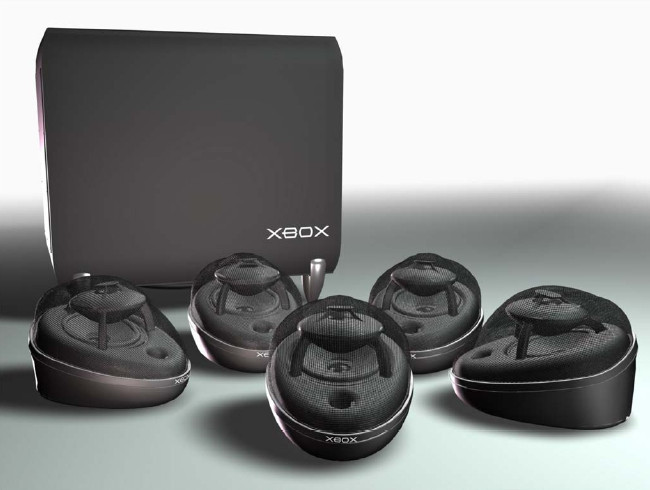
Spherex Inc., 3641 McNicoll Avenue, Toronto, Ontario M1X 1G5, Canada. Voice: (416) 321-6211. Fax: (416) 321-1500. Web: www.spherexinc.com. Xbox 5.1 Surround Sound System, $180 to $210 (lowest Internet prices). Tested sample owned by The Audio Critic.
Bad news for the high end. Very bad news.
Actually it’s not news because the Xbox 5.1 Surround Sound System is more than two years old. And it’s bad for the high end only because I say so; other reviewers did not have the guts, or the self-confidence, to say that it produces unmistakably high-end sound for only $180! That’s bad for business only if potential high-end customers know about it, but they don’t. Maybe they will now. (The price may have gone up a bit since I paid $180 to amazon.com for my set; the lowest price I see these days on the Web is around $210.) That unbelievable price buys you a complete system: five satellite speakers, subwoofer, amplifiers, surround-sound processor, D/A conversion, remote control, the works.
Now, there’s a reason why the Xbox 5.1 isn’t widely known as a music system. It was engineered specifically as a multimedia audio platform for Microsoft’s Xbox 360 gaming console. All promotions and all reviews have been about surround sound for video games. The fact is, however, that the technical solutions for the best possible gaming audio are the same as for the best possible music audio. The circuits and transducers don’t know whether they are transmitting video-game sounds or Beethoven. I happen to know absolutely nothing about video games; during my three decades of involvement with computers I haven’t played a single video game; but I do know something about the sound of Beethoven and other music in the concert hall, and I can confidently say that the Xbox 5.1 renders a pretty damn convincing version of it.
I’ll go even further. Going from the Xbox 5.1 to the very best systems known to me (represented by the Bang & Olufsen BeoLab 5 and the Linkwitz Lab “Orion”), there are very few in-between steps of improvement. Maybe only two or at most three. It’s that close. Let the high-end police come and take me away in handcuffs.
The Design
Unlike most other inexpensive systems, the Xbox 5.1 isn’t an ad hoc assembly of preexisting generic components. Its parts were designed from the ground up to work with one another; it’s engineered as a unique integrated system, and that’s why it performs so beautifully at minimum cost. Anyone can design and put together a cost-no-object system; it takes real engineering to maximize performance at the lowest possible cost. The company responsible for the design is Audio Products International (API) of Canada; Spherex Inc. is a subsidiary of API. (Other API brands are Energy, Mirage, Athena Technologies, Energy Pro, and Sound Dynamics.) Ian Paisley, a name recognized by audiophiles everywhere, is the chief engineer of API.
A number of innovative technologies have gone into the design of the Xbox 5.1. Instead of describing each of them in detail here, I’ll ask you to go to http://www.biline.ca/spherex.htm, where the subject is covered about as thoroughly as can be, item by item, although a bit uncritically. (The website is that of Jeff Mathurin, a Canadian techie, computernik, and audio enthusiast, who among other things was responsible for compressing those 14 back issues of The Audio Critic into downloadable PDFs and who first pointed out to me the superiority of the Xbox 5.1.) I happen to have some unresolved reservations about the theory of a 30/70 percent direct/reflected sound ratio with 360° dispersion in loudspeaker design, but in practice the approach appears to work just fine, at least in this case. (What I don’t quite understand is the reason for “30/70-ing” a signal which has already been “30/70-ed” by the acoustics of the recording venue. Twice 30/70 is better than once? Maybe there’s an explanation.)
About the only feature of the Xbox 5.1 that I find less than satisfactory is the Waves “MaxxBass” low-frequency implementation system (again, see the above Web link). Instead of actually reproducing the lowest frequencies down to 25 Hz or so, MaxxBass fakes them by generating characteristic harmonics that mimic the particular low frequency. The mimicry is fairly plausible, but the room doesn’t actually get energized and your innards don’t get shaken by the organ pedal tones or the T. Rex steps. In reality the 8-inch woofer goes down only to about 50 Hz at best. It’s a compromise that blunts the high-end effect. The five satellite speakers, on the other hand, need no apology.
The Measurements
The Xbox 5.1 is a closed-loop system, from digital (or analog line-level) input to acoustic (speaker) output. You cannot break into the loop and make valid measurements of the various components because the latter cannot be isolated in their simplest “flat” mode. Nor can you make quasi-anechoic (MLS) measurements of the satellite speakers because their very principle of operation is “echoic,” based on reflected sound. Those constraints limited the measurements I was able to make. I used the optical digital input for my signal feed and made some close-miked nearfield measurements of one speaker. That’s about all. Unfortunately, such measurements do not reveal the true quality of the total system when it comes to actual listening. I am sure that API’s more comprehensive and sophisticated measurement techniques track the audible performance more closely. My methods are better suited to separate components.
Fig. 1 shows the nearfield frequency response of the front left speaker channel on the vertical axis and the side-firing axis. From about 500 Hz upward, if you split the difference between the two curves you get a reasonably flat characteristic. This, of course, has little to do with the 30/70 percent direct/reflected response of the speaker.
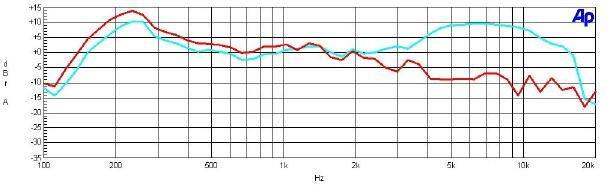
Fig. 1: Nearfield frequency response of the front left speaker channel on the speaker’s vertical axis (cyan) and its side-firing axis (red).
The woofer is easier to measure. With the classic Don Keele nearfield technique, I obtained the curve shown in Fig. 2 at a medium-loud signal level. The humpbacked response characteristic is due to the steep crossover slope (which cannot be bypassed) and the relatively narrow flat response band of the woofer, about an octave wide. Below 40 Hz something obviously not quite kosher is taking place—that’s the MaxxBass.
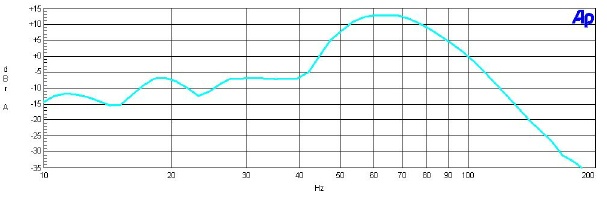
Fig. 2: Nearfield frequency response of the woofer.
Fig. 3 offers some explanation regarding the operation of the MaxxBass. The nearfield spectrum of a 20 Hz tone at a 1-meter SPL of 80 dB shows a third harmonic (60 Hz) 21 dB louder than the fundamental! The fourth harmonic (80 Hz) is at about the same level as the fundamental and the fifth harmonic (100 Hz) is 6 dB louder. The harmonics, intended to synthesize a fake 20 Hz tone for the ear, obviously dominated the SPL reading.

Fig. 3: Nearfield spectrum of a 20 Hz tone reproduced by the woofer, at a 1-meter SPL of 80 dB.
The woofer response curves clearly show what I heard: very little genuine deep bass, lots of tricky synthetic bass. Here the measurements and the listening experience correspond.
The Sound
Listening to 5.1-channel SACDs, I was amazed by the utterly natural, spacious, dynamic surround sound produced by the Xbox 5.1, lacking only in “pressure bass,” as I already explained. The openness of the reproduced sound was remarkable, providing a strong argument for the geometry of the satellite speaker design. There appeared to be no obvious limitations to loudness; the orchestral climaxes were full strength in my rather large listening space. Closing my eyes, it was easy to pretend that I was listening to a costly high-end system. I find it incredible that other reviewers did not pick up on this. Bad for business?
Recommendation
If you are an audiophile who is not totally under the spell of the tweako/wacko high-end magazines, here’s my advice to you: Be the last of the big-time spenders! Go online and order the Spherex Xbox 5.1 as your second system. If I am all wet and Xbox 5.1 is no damn good, you’ll be out two bills. Big deal. If I am right, your second system will be good enough to be your first system, or close to it. It’s a fair gamble.
By, Nicolas WardNicolas Ward is an elite author with many years of experience in the music field and the owner of many engaging articles at TheAudioInsights. He studies music production and has many years of passionate research into sound systems. Appearing in many popular newspapers, Nicolas Ward provides useful knowledge and the latest information on music and sound.